


6 Core Tools Every Automotive Quality Auditor Must Master

A supplier audit rarely fails because a document is missing. It fails because the auditor can’t connect one document to the next: a control plan that doesn’t match the PFMEA sitting beside it, or a PPAP submission signed off on a gauge nobody ever studied for repeatability. That gap, between knowing a tool and knowing how it connects to the next one, is where recalls, warranty claims, and failed audits actually come from.
APQP, Control Plan, PPAP, FMEA, MSA, and SPC are the automotive Core Tools. AIAG publishes all six manuals. Two of them, the FMEA Handbook and the SPC Manual, are joint AIAG-VDA documents. These are the current editions, checked against the AIAG and VDA publisher pages in October 2026:
APQP: 3rd edition (AIAG)
Control Plan: 1st edition (AIAG only, not an AIAG-VDA document)
PPAP: 4th edition (AIAG)
FMEA: AIAG-VDA FMEA Handbook, 1st edition
MSA: 4th edition (AIAG)
SPC: AIAG-VDA SPC Manual, 1st edition
Most auditors entering automotive can define each tool on its own. Far fewer can trace one part characteristic through all six documents and explain how a design requirement becomes an approved, capable production process. That is the difference between an auditor who checks boxes and one that clients and employers trust with a real supplier file.

1. Why These Six Tools Sit at the Center of Automotive Quality Audits
The Core Tools are not a separate curriculum added on top of IATF 16949. They are how the standard gets done on the shop floor. IATF 16949 asks for a control plan (clause 8.5.1.1), measurement system analysis (7.1.5.1.1) and a product approval process (8.3.4.4) in fairly general words. The Core Tool manuals show what a good answer looks like.
You may also hear people say "the 5 core tools". That is the older grouping: APQP, FMEA, MSA, PPAP and SPC, with the control plan sitting inside the APQP manual. Since APQP 3rd edition the Control Plan has its own manual, so we count six. When a customer or a job post says five, they usually mean the older set.
An auditor does not read these as six folders. The PPAP package, FMEA, control plan, MSA study and capability data are read as one connected story. This guide helps you read that story.
2. APQP: Advanced Product Quality Planning (3rd Edition)
APQP is the timeline the other five tools live inside. It takes a new part from the customer's request to full production in five phases:
Plan and define
Product design and development
Process design and development
Product and process validation
Feedback, assessment and corrective action (launch)
Each phase has defined outputs and a gate review before the next one starts.
Latest edition: APQP 3rd edition (AIAG, 2024). It is a real update, not a reprint. It reflects agile product development and adds sections on sourcing, change management, APQP metrics, risk assessment and mitigation plans, gated management and part traceability. The Control Plan content moved out into its own manual. AIAG states that GM and Stellantis required implementation from 1 September 2024, and Ford from 31 December 2024. Always check the customer-specific requirements of your OEM.
What auditors check: APQP is rarely audited as a document of its own. You audit it through its outputs. If a supplier can show a timing chart but not the Design FMEA that should exist at the design verification gate, or the validation data that should exist before launch, the timing chart is decoration. Ask for evidence that a gate was passed before the next phase began, and who signed it.
Common finding: a cross-functional team on paper, but only quality attended the reviews. Check attendance records and open actions.

3. Control Plan (1st Edition)
A control plan describes exactly how a process controls a product characteristic: what is measured or checked, how often, with which gauge, by whom, and what happens when a result is out of specification. It is a working document on the floor, not a launch form.
Latest edition: Control Plan 1st edition (AIAG, 2024). This is an AIAG manual only, so do not call it AIAG-VDA. Until APQP 3rd edition, the control plan lived inside the APQP manual. The standalone manual adds a Safe Launch requirement, examples for highly automated manufacturing, guidance on software for building and managing plans, and clearer rules on special characteristics, pass-through characteristics, error-proofing verification, reaction plans, rework and repair, and 100% visual inspection.
Stages: the manual expects a control plan for each stage of the part’s life.
Prototype: checks while the design is still fluid.
Pre-launch: tightened controls for early runs.
Production: the steady-state plan, with Safe Launch controls where they apply.
Controls tighten as the process matures.
Common finding: a control plan written once at launch and never touched after an engineering change, a tooling change or a PFMEA revision. The floor then controls something different from what the customer was told. Trace one characteristic from the PFMEA to the control plan to the operator's work instruction. If all three agree, the system is probably real. Also read the reaction plan. It should say what the operator does, not only "inform supervisor".
4. PPAP: Production Part Approval Process (4th Edition)
PPAP is how a supplier shows, part by part, that its production process makes parts that meet every customer engineering requirement. It is not a hand-built sample. The parts come from a significant production run, with production tooling, gauges and operators, at production rate.
Latest edition: PPAP 4th edition (AIAG, in use since 2006). It is still the current edition. It lists up to 18 elements. The ones an auditor asks for most:
Design records and engineering change documents
Process flow diagram, PFMEA and control plan
Dimensional results, plus material and performance test results
MSA studies (Gage R&R) for every gauge named in the control plan
Initial process studies with capability indices
The Part Submission Warrant (PSW)
It also defines five PPAP submission levels:
Level 1: PSW only
Level 2: PSW with product samples and limited supporting data
Level 3: PSW with product samples and complete supporting data (the default unless the customer says otherwise)
Level 4: PSW plus other requirements the customer defines
Level 5: the full package, reviewed at the supplier’s manufacturing site
Customer-specific requirements often add to this.
Where auditors get caught: first, the submission level on file is not the level the customer asked for. Second, PPAP was not repeated after a change that should have triggered it, such as a tooling move, a sub-supplier change or a process relocation.
5. FMEA: Failure Mode and Effects Analysis (AIAG-VDA 1st Edition)
FMEA asks a simple question before anything is built: what could go wrong, and what are we doing about it before it does? Design FMEA (DFMEA) looks at failure modes built into the product. Process FMEA (PFMEA) looks at failure modes the manufacturing process could introduce.
Latest edition: AIAG-VDA FMEA Handbook, 1st edition (2019). It was the first Core Tool AIAG and VDA wrote together. It uses a seven-step approach:
Planning and preparation
Structure analysis
Function analysis
Failure analysis
Risk analysis
Optimization
Results documentation
The old single Risk Priority Number has largely been replaced by Action Priority (High, Medium, Low), which looks at severity, occurrence and detection together, with severity leading. It also adds a supplemental FMEA for Monitoring and System Response (FMEA-MSR).
What auditors check: currency. An FMEA done once at launch and never updated after a field complaint, a line change or a customer return is a paper exercise. Check that High priority items have actions or a documented reason. Check that special characteristics and controls from the PFMEA appear in the control plan. Check which format the supplier uses, the old RPN or Action Priority, and whether the customer accepts it.
6. MSA: Measurement Systems Analysis (4th Edition)
Every number in a control plan, every SPC chart and every dimension in a PPAP file depends on a measurement. MSA tests whether the measurement system can be trusted, including the variation added by the gauge, the method and the people using it.
Latest edition: MSA 4th edition (AIAG, 2010). It is still current. It covers bias, linearity and stability, repeatability and reproducibility (Gage R&R), and attribute studies such as go/no-go gauges and visual inspection. A common rule of thumb for a variable gauge Gage R&R study:
%GRR under 10%: acceptable.
%GRR between 10% and 30%: may be accepted, depending on the application and the customer.
%GRR over 30%: not acceptable; the gauge needs work.
Distinct categories: 5 or more.
What auditors miss: calibration is not MSA. A gauge can be in calibration and still be unfit for a tight tolerance because of poor repeatability or operator-to-operator differences. Ask for the study, not the calibration sticker. Check that the study used the production gauge, the real operators and parts across the process spread. Check that every gauge named in the control plan has an MSA study, or a reason why it does not.
7. SPC: Statistical Process Control (AIAG-VDA 1st Edition)
SPC turns ongoing measurement into an early warning system. Control charts show whether a process is stable and predictable. Capability and performance indices (Cp, Cpk, Pp, Ppk) show whether it can meet the tolerance. The point is to react before bad parts are made.
Latest edition: AIAG-VDA SPC Manual, 1st edition (2026). AIAG and VDA published it jointly, with sales starting 1 July 2026. It is the second Core Tool the two organisations have harmonized, after the FMEA Handbook. It replaces differing AIAG and VDA approaches with one terminology and one framework for process management, performance and capability, and control charts. It is new, so ask each supplier how and when they are moving to it, and what their customer requires. Do not assume every OEM has set a date.
What auditors check: the question is not whether charts exist. It is whether anyone acts on them. Pick a chart and ask what the operator did the last time a point went out of control. If the answer is nothing, the chart is wallpaper. Check that control limits come from the process, not copied from the tolerance, and that the characteristic had an MSA study first. As a common rule of thumb, many customers expect Ppk of 1.67 or higher on special characteristics in the initial study and Cpk of 1.33 or higher in ongoing production. The customer's number always wins.
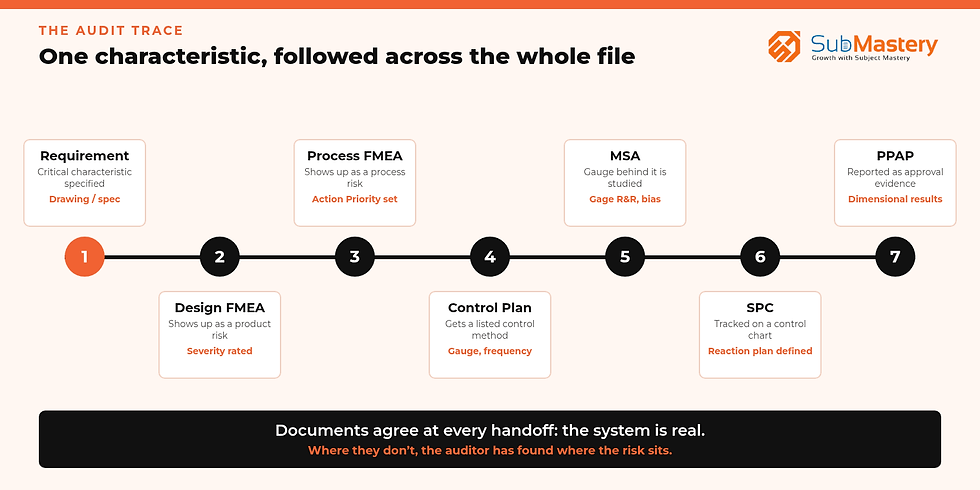
8. How the Six Tools Connect: Reading One Characteristic Across the Whole File
The six tools are not six separate audit stops. They are one thread. Pull a single critical characteristic and follow it. Here is an illustrative example, not a real supplier: the bore diameter on an aluminium brake caliper housing, 24.00 mm plus or minus 0.05 mm, marked by the customer as a safety-related special characteristic.
Customer requirement and APQP: the drawing flags the bore as special. The APQP plan carries it through design and process validation gates.
Design FMEA: a bore that is too large lets the piston leak fluid. Severity is high.
Process FMEA: the finish boring operation can drift as the tool wears. Control chosen: in-process gauging every 30 parts and a tool life limit.
Control Plan: same characteristic, same gauge, same frequency, same reaction plan, same special characteristic symbol.
MSA: the air gauge is studied with the real operators. If the gauge uses up 40% of a 0.10 mm tolerance, the readings cannot be trusted.
SPC: an X-bar and R chart on the bore, and the operator knows to stop and sort after a defined signal.
PPAP: dimensional results, the MSA study and the initial process study for this bore appear in the submission, with the same gauge ID and the same numbers.
A supplier whose documents agree at every handoff almost certainly has a working quality system behind the paper. A supplier whose documents do not agree is showing you where the real risk sits, even if each document looks complete alone. Four quick handoff checks:
1. Characteristic names, numbers and special characteristic symbols match across DFMEA, PFMEA, Control Plan and PPAP.
2. Every gauge in the control plan has an MSA study.
3. Every characteristic on an SPC chart appears in the control plan.
4. Revision dates line up after any change.
9. Building Real Competence Across All Six Tools
Most training builds competence in each tool separately. A module on FMEA, a module on SPC, a module on PPAP. That’s efficient for teaching, but it doesn’t reflect how an actual audit or an actual production launch works. Three habits build the kind of fluency that holds up in a real supplier file:
Trace one characteristic end to end, every time you study a tool. Don’t learn FMEA from a generic worksheet; learn it by following a single dimension from a real design FMEA through to a real control plan and PPAP submission.
Work from real documents, not templates. A blank FMEA form teaches the format. A completed, imperfect, real FMEA, the kind with revision history, warranty data references, and inconsistencies to spot, teaches the judgment an auditor actually needs.
Learn where the tools are deliberately allowed to differ before learning where they must agree. A prototype control plan isn’t supposed to look like a production control plan; a Gage R&R acceptable for a non-critical characteristic isn’t the standard a safety characteristic needs. Knowing the exceptions is what stops an auditor from either missing a real gap or flagging a non-issue.
From Tool Knowledge to Audit-Ready Competence
Knowing what APQP, Control Plan, PPAP, FMEA, MSA, and SPC stand for is the easy part. Most people working in automotive quality can recite the acronyms within a week. What separates a credible auditor, and a credible supplier quality engineer, is the ability to move between all six documents for a single part and know immediately whether the story they tell adds up. That’s not a one-afternoon skill. It’s built the same way the tools themselves are meant to work: slowly, and checked against real evidence at every stage.
Conclusion
In conclusion, the six Core Tools (APQP 3rd edition, Control Plan 1st edition, PPAP 4th edition, AIAG-VDA FMEA 1st edition, MSA 4th edition and AIAG-VDA SPC 1st edition) are not six things to memorize in isolation. They are one connected system that runs underneath IATF 16949 and every credible automotive supplier audit. An auditor who knows the current editions and can trace a single characteristic through all six, end to end, brings a different level of value to a certification body, an OEM or a supplier's own quality team than one who can only define the acronyms.
Whether you’re preparing for your first automotive audit or sharpening a credential you’ve held for years, building that cross-tool fluency properly, with real documents and a structured method rather than six disconnected modules, is what SubMastery’s IATF 16949 Core Tools training is built around.

Frequently Asked Questions
Are the six Core Tools part of the official IATF 16949 standard, or a separate framework?
They are separate reference manuals. AIAG publishes APQP, Control Plan, PPAP and MSA. The FMEA Handbook and the SPC Manual are joint AIAG-VDA documents. IATF 16949 requires their use. The standard sets the requirement, and the Core Tools are how a supplier shows it was met.
What’s the real difference between a Design FMEA and a Process FMEA?
A Design FMEA looks at failure modes that could be built into the product itself, a part that’s weak, under-toleranced, or prone to a design-related failure. A Process FMEA looks at failure modes the manufacturing process could introduce into an otherwise sound design, a station that could miss an operation, a fixture that could allow a part to be loaded backward. Both feed the same control plan from two different directions.
Do I need to memorize the AIAG-VDA Action Priority tables to audit FMEAs properly?
You need to understand how severity, occurrence, and detection combine to drive an action priority, and be able to judge whether a supplier applied that logic consistently. Memorizing the exact ratings table matters less than being able to spot an FMEA where high-severity items were quietly left without an action.
Is PPAP only required for brand-new parts?
No. A new part is the most obvious trigger, but an engineering change, a change of sub-supplier, tooling relocation, a significant process change, or a production gap can all require a new or partial PPAP submission. Auditors should always check whether a change event that should have triggered PPAP actually did.
How much statistics do I actually need to know to audit SPC properly?
Enough to read a control chart and a capability study correctly, understanding Cp/Cpk versus Pp/Ppk, recognizing special-cause signals, and knowing what capability level a characteristic’s risk level should demand. You don’t need to derive the formulas from scratch; you need to tell whether the chart in front of you is actually being used to control the process.
How long does it realistically take to get competent across all six Core Tools?
Long enough to matter, short enough to be worth doing properly. Most working auditors and quality engineers get fluent in each tool individually within a few weeks of structured training. The cross-tool tracing skill, following one characteristic through all six documents, typically takes deliberate practice on real files rather than slides, which is the gap a focused Core Tools course is built to close.
What are the latest editions of the Core Tools in 2026?
APQP 3rd edition, Control Plan 1st edition, PPAP 4th edition, AIAG-VDA FMEA Handbook 1st edition, MSA 4th edition and AIAG-VDA SPC Manual 1st edition. The SPC manual is the newest, with sales starting 1 July 2026. Customers may still reference older editions in their customer-specific requirements, so check each customer.
Is the Control Plan an AIAG-VDA document?
No. The Control Plan 1st edition is published by AIAG alone. Only the FMEA Handbook and the SPC Manual are joint AIAG-VDA documents.
Are there 5 or 6 Core Tools?
Both numbers are used. The older grouping of five (APQP, FMEA, MSA, PPAP, SPC) kept the control plan inside the APQP manual. Since APQP 3rd edition the Control Plan is a standalone manual, so we count six.
Is PPAP 4th edition still the current edition?
Yes. PPAP 4th edition, in use since 2006, is the current AIAG edition. Always read your customer's requirements as well, because many OEMs add their own PPAP rules.
What changed in the new Control Plan 1st edition?
It became a standalone manual and added a Safe Launch requirement, guidance for highly automated manufacturing, guidance on control plan software, and clearer rules on special characteristics, pass-through characteristics, error-proofing verification and reaction plans.
What are the five PPAP submission levels?
Level 1 is the Part Submission Warrant alone. Level 2 adds product samples and limited supporting data. Level 3, the default, is the warrant with samples and complete supporting data. Level 4 follows the customer’s own definition. Level 5 is the full package, reviewed at the supplier’s manufacturing site.
What is Safe Launch in the Control Plan 1st edition?
Safe Launch is a period of tightened controls, usually extra inspection and containment, applied at the start of production or after a major change, until the process has shown it is stable. The AIAG Control Plan 1st edition makes Safe Launch an explicit requirement instead of an informal practice.
Comments