


IMS Internal Auditor vs Standalone ISO Auditor: Which Path Pays More?

Abstract
Multi-standard IMS auditors earn a premium because one integrated audit costs an employer far less than three separate ones. This guide uses 2026 salary data from the US, UK and Ireland to compare the IMS and standalone paths. It explains the day-rate math behind the premium and shows how to go from one standard to three in a year.
For most people, the multi-standard path pays more over a career. Employers and certification bodies pay extra for auditors who can cover more than one standard, since one integrated audit costs them far less than three separate ones. The premium isn't automatic, though, and in some niches the single-standard specialist still comes out ahead. Here's what the evidence says.
The short answer
• Over a career, the multi-standard path pays more. One integrated audit costs employers and certification bodies far less than three separate ones, so multi-competent auditors get staffed first.
• The premium isn't automatic. Standalone specialists still win in regulated niches like ISO 27001, ISO 13485 and IATF 16949, where few people are qualified.
• Going from one standard to three in a year is realistic. ISO 9001, 14001 and 45001 share the same Harmonized Structure, so each new standard is mostly revision, not a new subject.
• Start with ISO 9001 either way. Every path, IMS or specialist, builds on it.
The two paths, defined
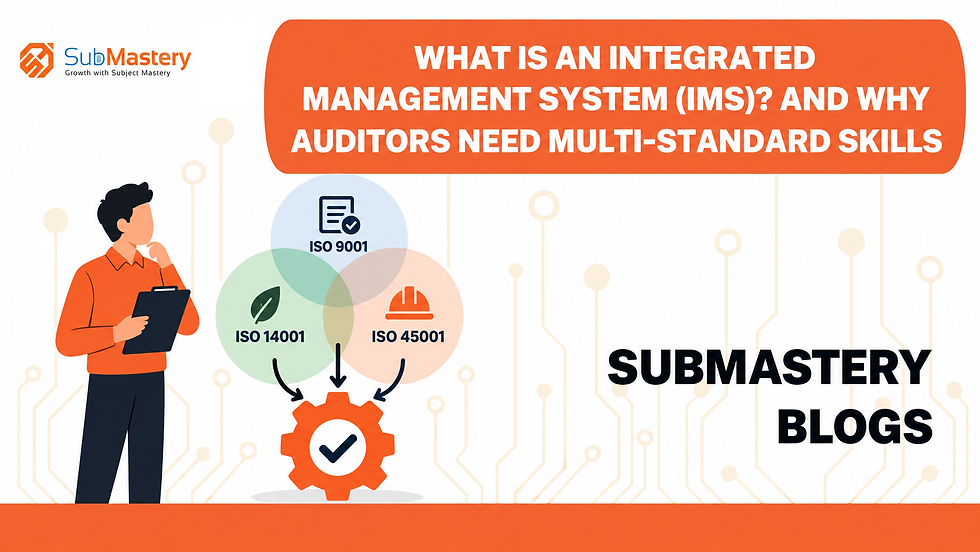
A standalone internal auditor trains in one management system standard, say ISO 9001 for quality, and audits that one system. An IMS internal auditor trains across the standards that make up an integrated management system, usually ISO 9001 (quality), ISO 14001 (environment) and ISO 45001 (health and safety), and audits all of them in one programme. ISO builds these standards on a shared clause structure, so the second and third take far less time to learn than the first.
Side by side
Standalone ISO auditor: audits one standard and one system, and covers one compliance pillar. It takes one course, so it's the fastest start. Pay is at the baseline, with a premium only in deep niches. Best fit: single-standard companies and niche sectors.
IMS internal auditor: audits three standards in one integrated audit, covering quality, environment and safety together. It's one bundled path that ends in three certificates, and it earns a premium for multi-standard coverage. Best fit: manufacturers running integrated QHSE systems.
What the pay data actually says
ISOCentral compiled 2026 ISO auditor salary data from Glassdoor, Payscale, Salary.com, Talent.com and SalaryExpert. It puts an ISO 9001 lead auditor at about GBP 48,460 on average in the UK and USD 77,304 in the US. Experienced practitioners reach GBP 60,000-plus and USD 100,000-plus. Freelance lead auditors bill roughly GBP 350 to GBP 600 per audit day in the UK and USD 1,200 to USD 1,400 in the US.
The same guide's first tip for raising your earning potential is to add a second or third standard. Qualifying across multiple standards makes an auditor much more attractive to certification bodies and supports higher contract day rates. The reason is simple: one multi-standard auditor can cover an integrated audit that would otherwise take two or three people and two or three times the audit

One certificate audits one system. Three certificates let you audit the integrated system most manufacturers actually run.

Why multi-standard auditors earn the premium
More companies now run one integrated QHSE system instead of three parallel ones, so they need auditors who can audit it as one system.
One combined audit means fewer audit days, less disruption and a single report for the client. That's why certification bodies staff multi-competent auditors first.
Inside a company, an IMS internal auditor covers three compliance pillars alone. That shows up in role scope, seniority and pay reviews.
For consultants, each extra standard is another service you can sell to the same client.
Where the standalone specialist still wins
Breadth wins on average, but depth wins in regulated niches. ISO 27001 auditors benefit from the cybersecurity talent shortage, with US averages around USD 102,886, well above general quality auditing. Experienced ISO 13485 medical device auditors regularly reach GBP 55,000 to GBP 70,000 in the UK because few people are qualified. In automotive, IATF 16949 auditors with real sector depth stay scarce and valued. The pattern is simple: specialize where regulation is heavy, and generalize where systems are integrated.
How to choose your path
Look at your sector. If the companies around you run integrated QHSE systems, as most manufacturers do, the IMS path matches the demand.
Decide whether you want to be employed or freelance. Freelance day rates reward breadth the most, because certification bodies book auditors who cover more in a day.
Check whether there's a regulated niche you want to own. If medical devices, information security or automotive is your world, a flagship single-standard certification can out-earn breadth.
Start with ISO 9001 either way. It's the shared foundation, and every path, IMS or specialist, builds on it.
The day-rate math behind the premium
Look at the numbers from the certification body's side. A manufacturer with an integrated QHSE system needs quality, environment and safety covered. Three single-standard auditors mean three sets of audit days, three reports and three opening meetings. One multi-competent auditor covers the whole system in a single visit.
That's why certification bodies staff multi-standard auditors first, and why freelance day rates reward breadth. An auditor who bills one day for an integrated audit is cheaper for the client and busier through the year. The premium isn't a reward for collecting certificates. It's the market price of coverage.
How to move from standalone to IMS in one year
Months 1 to 3: consolidate ISO 9001. Audit it until the clause structure is second nature, because ISO 14001 and ISO 45001 share the same Harmonized Structure skeleton.
Months 4 to 6: add ISO 14001 internal auditor training and join real environmental audits. The clauses will feel familiar. The aspects-and-impacts thinking is the only truly new part.
Months 7 to 9: add ISO 45001. By now you're learning differences, not structures, which is why the third standard comes fastest.
Months 10 to 12: audit integrated processes. That means one procedure that covers quality, environment and safety together, audited as one. This is the skill employers pay the premium for.
Twelve months is realistic because the standards were built to fit together. Under the shared Harmonized Structure, each added standard is mostly revision, not a new subject.

A practical example: one auditor's first integrated audit
An ISO 9001 internal auditor joins her first integrated audit as an observer. It's a paint-shop process audited against ISO 9001, ISO 14001 and ISO 45001 in one visit. She watches the lead auditor trace one batch through its quality checks, then ask where the solvent waste goes and how respirator fit-testing is recorded, all without changing rooms or restarting interviews.
Her notes from that day: the questions have the same shape, and only the evidence changes. Six months later she leads the ISO 9001 part of the integrated audit herself. A year later she holds all three certificates and runs the programme. The first day felt like three audits at once. By the third cycle it felt like one audit, which is the whole point.
The mistakes that slow the move
The first mistake is learning the standards as three separate worlds. Auditors who study ISO 9001, 14001 and 45001 in isolation keep tripping over the shared structure. Learn the Harmonized Structure once, and after that each standard is only its subject matter.
The second mistake is collecting certificates without audits. Three certificates and zero integrated audits make a weaker profile than one certificate and a logbook of real findings. Every certificate needs audit hours behind it.
The third mistake is waiting for permission. You don't need your employer to run an integrated system before you start. The certificate is yours and the method travels with you. The market pays for the combination whether or not your current plant uses it yet.
Put it into practice
If you hold one standard, pick the second one your industry actually pairs with it. In manufacturing that's ISO 14001 or 45001, in technology it's ISO 27001, and in automotive it's IATF 16949 with the core tools. Book the course within ninety days, and ask to join any integrated audit your certification body or employer runs, even as an observer. The premium grows with evidence, not good intentions.
Frequently asked questions
What is the difference between an IMS internal auditor and a standalone ISO auditor?
A standalone internal auditor audits one management system standard, such as ISO 9001. An IMS internal auditor audits an integrated management system that combines several standards, usually ISO 9001, ISO 14001 and ISO 45001, in a single audit programme.
Do multi-standard auditors really earn more?
The salary data points that way. Salary guides report that adding a second or third standard makes auditors much more attractive to certification bodies and supports higher freelance day rates, because one auditor can cover an integrated audit that would otherwise need two or three people.
Can I audit an IMS with a single-standard certificate?
You can take part in an integrated audit that covers your standard, but you can only audit the parts you're competent in. To audit all three pillars of an IMS yourself, you need training in each standard. That's what an IMS internal auditor bundle provides.
Which standard should I learn first?
ISO 9001. It shapes how most organizations think about their management system, and ISO 14001 and ISO 45001 share its structure, so the second and third standards come much faster.
When does a single-standard specialization pay better?
In deep, regulated niches. ISO 27001 auditors benefit from the cybersecurity premium, with US averages around six figures, and ISO 13485 medical device auditors command top UK salaries because the talent pool is small. Breadth wins on average. Depth wins in the right niche.
Is this salary data specific to India?
No. The figures here are 2026 data for the UK, US and Ireland from published salary guides, used as rough benchmarks. Indian salaries sit at a different level, but the pattern holds wherever companies run integrated systems: multi-standard competence earns a premium


Comments