


What Is an Integrated Management System (IMS) and Why Auditors Need Multi-Standard Skills
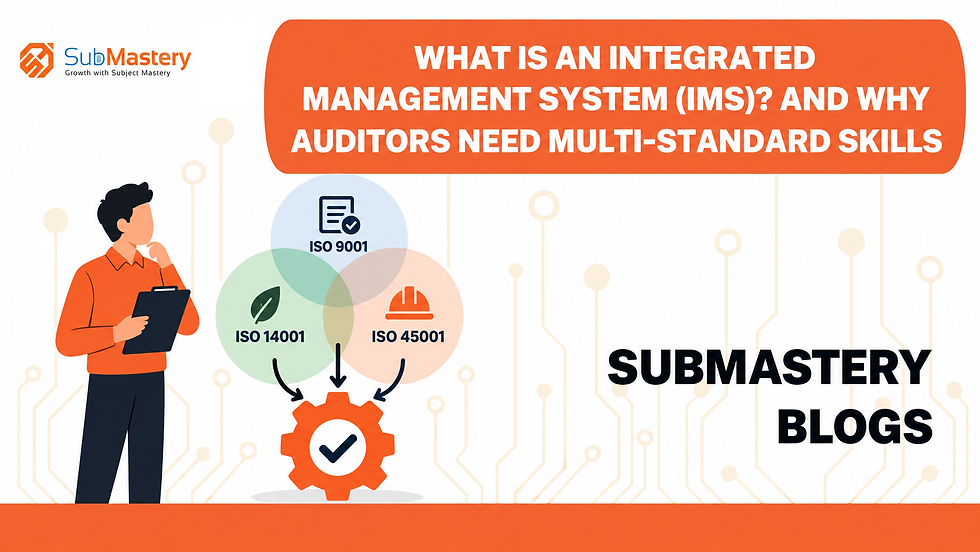
Walk into any mid-sized manufacturing plant and ask how they manage quality, environment, and safety. Not long ago the honest answer was three manuals, three coordinators, three audit schedules, and three management reviews, all covering much of the same ground. Today, more organizations run one system instead: an Integrated Management System (IMS), a single framework that combines two or more ISO management system standards, most commonly ISO 9001 (quality), ISO 14001 (environment) and ISO 45001 (occupational health and safety), into one set of policies, processes and audits. That shift is changing what companies expect from the auditors they hire and the professionals they promote.
What is an Integrated Management System (IMS)?
An Integrated Management System (IMS) is a management system that combines two or more ISO standards into one shared framework. The most common combination is ISO 9001 for quality, ISO 14001 for environment, and ISO 45001 for occupational health and safety, often called a QHSE system. Instead of running each standard as a separate system, the organization runs one set of processes, one policy, one set of objectives, and one internal audit programme that satisfies them all together.
An IMS is not limited to these three. Organizations add what their industry demands: ISO 50001 for energy, ISO 22000 for food safety, ISO 27001 for information security, or IATF 16949 for automotive quality. In this article and in our course we work with the classic trio: ISO 9001, ISO 14001 and ISO 45001.
The word that matters is "integrated". Three standards sitting in the same folder is not an IMS. In a real one, a single process covers the shared requirements of every standard, so nobody does the same job three times.
Why do ISO standards integrate so easily? The Harmonized Structure
ISO writes its management system standards around a shared high-level structure, originally introduced as Annex SL and now known as the Harmonized Structure. ISO 9001, ISO 14001, ISO 45001 and most other management system standards follow the same ten clauses:
Scope
Normative references
Terms and definitions
Context of the organization
Leadership
Planning
Support
Operation
Performance evaluation
Improvement
How to remember these clauses
SNT | CLPS | OPI
SNT (clauses 1 to 3): 1 Scope, 2 Normative references, 3 Terms and definitions
CLPS (clauses 4 to 7): 4 Context of the organization, 5 Leadership, 6 Planning, 7 Support. Say it like the word "clips", and keep the I silent: there is no I in these four clauses.
OPI (clauses 8 to 10): 8 Operation, 9 Performance evaluation, 10 Improvement
Write the three groups together as SNT, CLPS and OPI and you have all ten clauses in order. (One small note: ISO 45001 words clause 5 as "Leadership and worker participation", but it is the same clause 5.)
From clause 4 onward, the core text is largely identical across standards. Each standard then adds its own layer on top: customer focus in ISO 9001, lifecycle perspective in ISO 14001, hazard identification, worker participation and psychosocial risks in ISO 45001. This is why building an integrated management system works. You build the shared skeleton once, and each standard plugs its own requirements into it.

What does an IMS look like in practice?
One policy and one set of objectives covering quality, environment and safety together, instead of parallel statements that drift apart over time.
Shared core processes: document control, competence and training, risk and opportunity planning, corrective action, and management review run once for the whole system.
One internal audit programme that looks at all three standards in the same visit.
A single management review where leadership sees quality, environmental and safety performance side by side.
Discipline-specific processes kept only where the standards genuinely differ, such as emissions monitoring or product inspection.
What are the benefits of an IMS?
The benefits of an IMS show up in two places: in the organization that runs it, and in the people who know how to work with it.
Benefits for companies and organizations
Lower cost. One system to maintain, review and audit costs less than three parallel ones.
No duplicate documentation. One procedure for document control, training or corrective action replaces three near-identical ones.
Less workload on people. Staff fill in one set of records and attend one set of reviews, instead of repeating the same work for each standard.
One view for leadership. Quality, environmental and safety performance are discussed together, so decisions are not made in silos.
Benefits for learners and professionals
Wider competence. You learn the shared structure once and understand how three disciplines connect.
More career options. You are not tied to one function. Quality, environment and safety roles all become easier to move into.
A stronger position for consultants and trainers. You can serve the same client on more than one standard.
Why do auditors need multi-standard skills?
The simple reason: companies now run one system, so they expect to be audited as one system. An auditor who only knows ISO 9001 can look at one slice of it. Three separate audits also mean more audit days, more preparation and more interruptions for the people being audited, and plenty of organizations are already tired of audits.

Combined audit vs integrated audit: what is the difference?
ISO 19011, the auditing guidelines standard, calls an audit of two or more management systems at one auditee a combined audit: several standards assessed in parallel during the same audit cycle, each still evaluated on its own. An integrated audit goes further. The systems have been merged into one structure with shared documentation and processes, and the audit follows that shape: one plan, one set of interviews, one report, with each finding traced to the standard or standards it breaches. Both models save time and reduce disruption. Auditors who cannot work across standards get left out of both.
What this means for a company
A certification body can audit the standards together in one combined audit. It is not effortless: the audit needs more planning, and the audit team must be competent in every standard it covers. The payoff is that cross-links and references between the standards get checked at the same time, so gaps between systems show up early. When the formats for procedures, records and reviews are common, people are not buried under three versions of the same paperwork.
Why does IMS competence raise your value?
You raise your own competence, and your company's capability
Take a management representative who has spent years on the QMS. Once that person learns the environmental and safety standards as well, they bring more to the table: they can run one system, not just one slice of it, and the company gets an in-house person who can hold the whole system together. It works the other way too. An EHS professional who understands quality management is a stronger candidate when jobs or vacancies open up, because they already speak the language of the other functions. Either way, more capability means more respect, and it moves you up.
Your lifetime value rises with every standard you add
If you are a consultant, trainer or expert, think about what happens when a client trusts you on one standard. The next question is usually: "Can you help us with the others?" If the answer is yes, that client stays with you instead of going to someone else. You earn more per client, and you keep them for longer. For anyone who sells expertise, multi-standard knowledge is close to a must-have, because it lifts both your average order value and your lifetime value with each client.
The IMS can grow beyond three standards
Many organizations also add other standards to the same system. In this course we take the three core standards: ISO 9001, ISO 14001 and ISO 45001. Learn them well, and the next standard is much easier to add, because the structure is already familiar.
Do multi-standard auditors write better findings?
Yes, and the reason is simple: real risks do not stay inside one standard. A change on the shop floor can affect product quality, emissions and worker exposure all at once. A single-standard auditor sees one part of that. A multi-standard auditor can sit with one process owner, ask about quality, environment and safety in the same conversation, and write findings that match how the plant actually runs. A finding against a shared requirement, like document control or management review, hits the whole system, which is why those findings carry more weight.
A worked example: one paint-shop change, three standards
This is a made-up example, not a real client. Say a fabrication shop swaps its paint supplier. The new high-solids coating is cheaper and dries faster, so the purchasing team signs it off and everyone moves on. Nobody thinks of it as a big change. Then an auditor does one integrated audit of that single change, walks into the paint shop and starts asking questions.
Here is what comes out of that one conversation with the supervisor:
ISO 9001: "Who approved this supplier?" Nobody evaluated the new paint company as an external provider before the switch. First finding.
ISO 14001: "Did the solvent emissions change?" They did, and so did the paint waste. But the environmental aspects register and the compliance-obligations check still describe the old paint.
ISO 45001: "What are the workers breathing now?" Different solvents mean different exposure hazards. Hazard identification (clause 6.1.2) was never re-run, so the ventilation and PPE may not match the new risk.
One process owner, one interview, three findings. Three separate single-standard audits would probably have caught these late, or missed some of them. That is the day-to-day difference an integrated audit makes.
If you want to try this on your own site, ask these four questions the next time something changes:
Did anyone check the quality, environmental and safety impact before the change started?
Do the supplier file, the aspects register and the hazard records all show the change?
Were the affected people told, and trained if they needed it?
Can you tie each finding to the right standard, and to the shared requirement behind it?
Is multi-standard competence more than three certificates?
Knowing the clauses of three standards is where you start, not where you finish. The real skill is understanding the common core well, knowing where each standard goes its own way, and auditing processes instead of clauses. In practice, take one real process, like purchasing, maintenance or dispatch, and follow it through every standard that touches it. Then you know which standard each answer belongs to.
How do you become a multi-standard (IMS) auditor?
Master one standard properly first, usually ISO 9001. It is the backbone everything else attaches to.
Learn the common Harmonized Structure once. After that, each new standard is mostly its discipline-specific additions, a much smaller lift than starting from zero.
Add the standards your industry actually runs. For most manufacturing professionals, that means ISO 14001 and ISO 45001 next.
Practice integrated auditing. Shadow or join a combined internal audit as early as you can; auditing several standards in one conversation is its own skill.
Stay current as standards revise. ISO 9001:2026 (sixth edition) has a transition window running to September 2029, and ISO 14001:2026 is here too, so transition knowledge is part of the job now.
Browse the full catalog on SubMastery courses.
What are the latest editions of ISO 9001, ISO 14001 and ISO 45001?
All three standards in the IMS trio have moved recently, and auditors are expected to know where each one stands. Here is the picture as of October 2026:

ISO 9001:2026
Sixth edition, replaces ISO 9001:2015. The revision puts more weight on leadership, quality culture and ethical behaviour, ties the quality policy closer to business strategy, and separates managing risk from pursuing opportunities. The 2024 climate-change amendment carries forward. Certified organizations get a three-year transition window, running to September 2029. ISO 9001:2026 Lead Auditor course
ISO 14001:2026
Fourth edition, published April 2026, replaces ISO 14001:2015. It brings clearer guidance and easier navigation, stronger alignment to climate change, biodiversity and resource efficiency, and more emphasis on leadership, governance and impacts across the value chain. ISO says the new edition integrates more smoothly with the other management system standards, which is good news for anyone running an IMS. ISO 14001:2026 Lead Auditor course
ISO 45001:2018
First edition (2018), still current, and it replaced OHSAS 18001. It remains the edition to learn and audit against today, updated by Amendment 1:2024 on climate action. A revision has reached the Draft International Standard ballot stage but is not yet approved or published, so any "ISO 45001:2026" claim you see elsewhere is premature. ISO 45001 Lead Auditor course
Where can you learn IMS auditing?
If this article matches where you want to take your career, the next step is to learn the method properly. Our IMS Lead Auditor course trains you across the exact trio this article is about: ISO 9001:2026, ISO 14001:2026 and ISO 45001:2018, with auditing skills aligned to ISO 19011:2026. It is Exemplar Global certified, self-paced online with instant access, and you earn three separate lead auditor certificates, one per standard. Exams come with unlimited reattempts, and email support replies within 24 to 48 hours. If you are earlier in your journey, the IMS Internal Auditor course covers the same three standards at the internal audit level.
Frequently asked questions about IMS and multi-standard auditing
1. Is an IMS a separate ISO standard?
No. There is no standalone IMS standard to certify against. An integrated management system is an approach: you run one integrated system, and you certify it against the individual standards it covers, such as ISO 9001, ISO 14001 and ISO 45001.
2. Can one audit cover ISO 9001, ISO 14001 and ISO 45001 together?
Yes. Combined and integrated audits are standard practice for certification bodies and internal audit programmes alike, as long as the audit team as a whole is competent in every standard the audit covers. That competence requirement is exactly why multi-standard skills matter.
3. Which ISO standard should an auditor learn first?
Start with ISO 9001, since it underpins how most organizations think about their management system. Then add ISO 14001 and ISO 45001, which complete the classic IMS trio. Industry-specific standards like IATF 16949, ISO 22000 or ISO 27001 come after, based on the sector you work in or want to move into.
4. What is the difference between an IMS lead auditor and an IMS internal auditor?
An internal auditor audits their own organization's system to check it works and to prepare for external audits. A lead auditor is qualified to plan and lead full audit teams, including supplier audits and certification audits. If your goal is auditing as a career or consultancy, aim for the lead auditor level; if you support your company's own IMS, start with internal auditor training.
5. How long does it take to become an IMS lead auditor?
Classroom lead auditor courses usually run five days for each standard. Self-paced online IMS lead auditor courses vary with your schedule; SubMastery's gives you instant access for six months with unlimited exam reattempts, so most learners fit it around a full-time job.
6. What are the ten clauses of an ISO management system standard?
ISO 9001, ISO 14001, ISO 45001 and most other management system standards follow the same ten clauses: 1 Scope, 2 Normative references, 3 Terms and definitions, 4 Context of the organization, 5 Leadership, 6 Planning, 7 Support, 8 Operation, 9 Performance evaluation and 10 Improvement. A simple way to remember the order is SNT, CLPS, OPI: Scope, Normative references, Terms; Context, Leadership, Planning, Support (say 'clips', the I is silent); Operation, Performance evaluation, Improvement.
7. What is the difference between a combined audit and an integrated audit?
In a combined audit, two or more standards are assessed in parallel during the same audit cycle, and each is still evaluated on its own. In an integrated audit, the systems are already merged into one structure with shared documentation and processes, so the audit follows one plan, one set of interviews and one report, with each finding traced to the standard or standards it breaches.
8. Which edition of ISO 9001 is current, and when is the transition deadline?
ISO 9001:2026 is the sixth edition and replaces ISO 9001:2015. Certified organizations get a three-year transition window, running to September 2029.
9. Is there an ISO 45001:2026?
No. ISO 45001:2018 is still the current edition. A revision has reached the Draft International Standard ballot stage but is not yet approved or published, so any claim about an ISO 45001:2026 edition is premature.
10. What are the benefits of an integrated management system?
For an organization: less duplicate documentation, less workload on people and lower running cost than managing each standard separately. For a professional: wider competence, more career options, and for consultants and trainers, more ways to help the same client over time.
11. Can an IMS include standards other than ISO 9001, 14001 and 45001?
Yes. Because the standards share a common structure, organizations also integrate standards such as ISO 50001 (energy), ISO 22000 (food safety) or ISO 27001 (information security). The SubMastery IMS Lead Auditor course focuses on the three core standards: ISO 9001, ISO 14001 and ISO 45001.


Comments