


ISO 9001:2026 Explained: Key Changes, Timeline, and Transition Guide
Updated: Sep 9

Supply chain shocks, climate volatility, cyber risk, and the rise of AI have all pointed to the same lesson: organizations built purely for efficiency are not always built for disruption. Customers, regulators, investors, and supply chain partners no longer judge quality in isolation — they expect resilience, transparency, ethical leadership, and sustainable performance alongside consistent products and services. ISO 9001:2026 is the standard's response to that shift.
The Final Draft International Standard (FDIS) for ISO 9001:2026 has now been released, confirming the direction of the first meaningful revision to ISO 9001 since 2015. In the decade since, sustainability expectations have accelerated, climate-related risk has moved from boardroom conversation to regulatory obligation, and stakeholders increasingly want credible evidence that organizations can manage disruption responsibly. Quality itself is being redefined along the way — no longer measured by product or service conformity alone, but by an organization's ability to anticipate change, manage risk, adapt, and deliver sustainable long-term performance.
1. Why ISO 9001 Still Matters — and Why 2026 Raises the Bar
ISO 9001 remains the world's most widely adopted quality management standard, underpinning how organizations across every industry deliver consistent, compliant products and services. The 2026 revision doesn't tear that foundation down — it strengthens it, reflecting how far the definition of quality itself has expanded. Customers today rarely assess quality on its own; they weigh it alongside environmental footprint, workforce practices, supplier relationships, and governance. The direction is clear: from process effectiveness to integrated business performance, from customer satisfaction to stakeholder confidence, from operational control to organizational resilience, and from leadership commitment to ethical leadership and quality culture.
The revision also deepens alignment with other ISO management system standards — 14001, 45001, 50001, 27001, and 22301 — making integrated management systems more practical to run under a single coherent framework rather than as parallel, duplicative systems.

2. Where Things Stand: FDIS Status and Timeline
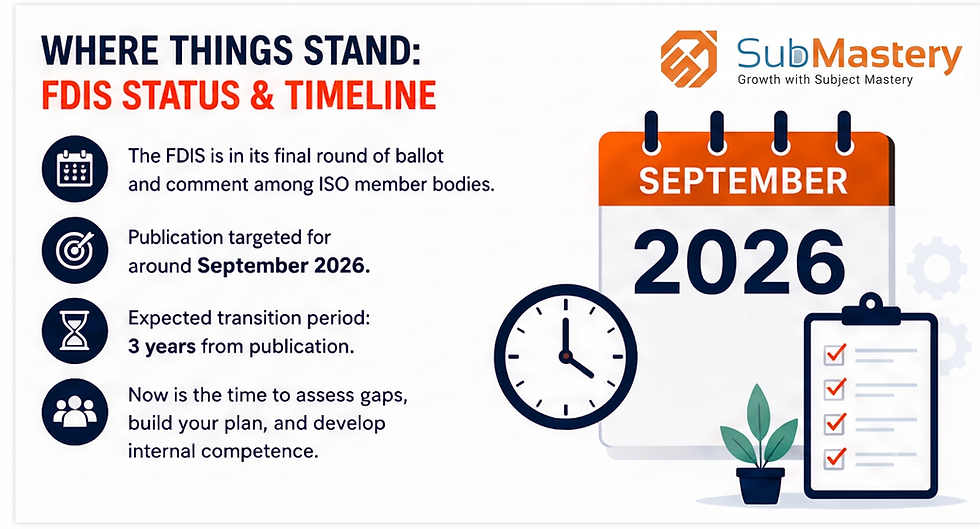
The FDIS is now in its final round of ballot and comment among ISO's national member bodies — the last formal step before publication, targeted for around September 2026. Once published, organizations currently certified to ISO 9001:2015 will need to transition by May 2029 i.e three years from publication, based on current guidance from the global accreditation community.
The FDIS effectively locks in the technical content of the standard, which means organizations already have enough visibility to begin structured preparation — assessing gaps, building a transition plan, and developing internal competence — well ahead of formal deadlines.
3. How Significant Are the Changes?
Overall, the scope of change is considered moderate — notably less extensive than the 2015 revision. Organizations already certified will experience this as an evolution of the existing framework rather than a rebuild. That said, moderate doesn't mean minor: several changes represent real shifts in what credible quality management now requires, particularly around sustainability integration, leadership accountability, and ethical conduct, along with smaller enhancements to knowledge management, customer communication during disruption, and infrastructure requirements for modern working environments.
Importantly, the core of ISO 9001 is untouched — the process approach, PDCA cycle, risk-based thinking, customer focus, continual improvement, organizational context, and leadership commitment all remain central. This is evolution, not reinvention.

4. Key Changes Organizations Need to Know
Climate change becomes an explicit requirement
ISO released an special update about climate change addition in Feb 2024, now that will be merged with upcoming standard. Clause 4 now explicitly requires organizations to assess whether climate change is relevant to the internal and external factors shaping their QMS, with knock-on implications for scope (4.3) and risk and opportunity (6.1). Environmental factors can no longer sit outside quality planning — but it's worth being precise: ISO 9001:2026 is not becoming an ESG standard. It's the management system that lets organizations operationalize existing ESG commitments in a structured, auditable way.
Quality culture, ethics, and accountability get stronger
Clause 5 raises the bar on leadership's role: top management must now actively promote quality culture and ethical behavior, not just support the QMS on paper. This extends into awareness requirements (7.3) and the work environment (7.1.4), pushing culture and ethics to be visible in leadership behavior and decisions — not just documented in policy.
Risk and opportunity are now treated separately
Clause 6 splits what used to be one general idea into two distinct, separately governed requirements: risks under 6.1.2 and opportunities under 6.1.3. In 2015, treating them together sometimes meant one got overlooked. Now organizations must show clear approaches to both — controlling risk to QMS performance and pursuing improvement opportunities with equal rigor.
Change management is strengthened
Clause 6.3 (with supporting implications across 5.3, 8.1, 8.2.1, 8.2.4, and 9.3) puts more weight on structured, controlled change — with greater emphasis on communication, monitoring, and review. This closes a common gap where changes were implemented without enough planning or follow-through.
Awareness and training now include quality culture
Clauses 7.2 and 7.3 expand competence and awareness requirements so employees understand not just QMS processes, but how quality and ethics show up in daily decisions — with clear implications for onboarding and ongoing communication programs.
A substantially expanded Annex A
The new Annex A — roughly 15 pages — provides significant interpretation support around structure, terminology, and clause intent, without introducing new mandatory requirements. For auditors, consultants, and system owners, it's a practical bridge between the written standard and real-world implementation.

5. Transition Timeline: What to Expect
Publication is targeted for September 2026, with a transition period expected to run three years from that date. Formal rules — specific dates, audit requirements — will follow from IAF and accreditation bodies after publication. But organizations don't need to wait for those formal dates to start preparing: the direction and content of the changes are already clear enough to act on. Early movers face less pressure later, more time to build internal competence, and a smoother transition audit cycle.
6. The Sustainability Connection
ISO 9001:2026 and ISO 14001:2026 reflect the same underlying shift — embedding sustainability into core management systems rather than treating it as a parallel initiative. ISO 14001:2026 deepens requirements around climate, biodiversity, and supply chains; ISO 9001:2026 brings climate and sustainability directly into the QMS context. Together they create a single, coordinated framework spanning environmental factors (Clauses 4.1, 4.2, 6.1, 9.3), social factors like competence and engagement (7.1.2, 7.1.4, 7.2, 7.3, 7.4), and governance (5.1–5.3, 6.2, 9.1, 9.3, 10.3). With ISO 45001 revisions expected in 2027, organizations that plan a coordinated approach now are laying the groundwork for a fully aligned quality, environment, and safety system.
7. How to Prepare: A Practical Approach
Early preparation isn't about rushing to implement changes before formal publication — it's about using the clarity the FDIS already provides to prepare deliberately rather than reactively. Practical steps include:
Understand the direction of change — brief key personnel on the sustainability integration in Clause 4, the culture and ethics expectations in Clauses 5 and 7, the risk/opportunity split in Clause 6, and the strengthened change management requirements.
Assess your current QMS against the updated requirements — an honest, structured gap review, focused especially on sustainability integration, leadership accountability, and cultural awareness.
Plan competence building early — internal auditors, QMS coordinators, and operational staff will all need updated training well before the transition deadline.
Look for integration opportunities — if you also hold ISO 14001 certification, the overlap between the two 2026 revisions makes a combined transition plan far more efficient than running them separately.
Stay close to your certification body — accurate, current guidance matters as formal transition rules are finalized.

8. From Compliance to Resilience: A New Chapter for Quality Management
Taken together, these changes mark a shift in what quality management means in practice — from a compliance framework to a resilience framework. By explicitly embedding climate considerations, ethical behavior, and quality culture into its core, while strengthening alignment with broader sustainability objectives, ISO 9001:2026 reflects how much the definition of quality has evolved since 2015.
For organizations already navigating ISO 14001:2026, the complementarity between the two standards is a real strategic opportunity. For those just beginning ISO 9001:2026 preparation, the message is simple: the changes are meaningful, the timeline is defined, and early action is the most effective path to a confident, well-managed transition.

Conclusion:-
ISO 9001:2026 marks the start of a new chapter for the world's leading quality management standard. It doesn't discard what has made ISO 9001 valuable for decades — it builds on that foundation with sharper expectations around climate awareness, ethical leadership, structured change, and a clearer split between risk and opportunity. For organizations, the practical takeaway is straightforward: this is a moderate revision with real substance, the FDIS gives enough clarity to start preparing now, and the organizations that treat this as a strategic upgrade — not a compliance checkbox — will come out the other side with a QMS that is more credible, more resilient, and better aligned with what customers, regulators, and investors already expect.
Whether you're maintaining an existing ISO 9001 certification or building your organization's first Lead Auditor capability, understanding these changes early is the difference between a smooth transition and a rushed one.
Build ISO 9001 Lead and Internal Auditor capability with SubMastery.
👉 Click on a course below to view details & enroll:-


Comments